OUR METHOD — FIELD OBSERVATION & SPATIAL ARCHIVE STOCKHOLM & UPPSALA STUDIES
EDITORIAL METHOD

Why We Map Gardens

We started vorkadscandipuzzle.garden because too much garden design advice treats a domestic plot like a showroom floor—requiring expensive contractors, heavy machinery, and total clearance before anything nice can happen.

M1
HANDS-ON EMPIRICISM

Measured with folding rules, tested with wheelbarrows

Our small team of landscape draughtsmen, horticulturists, and allotment gardeners works across central Sweden and coastal Denmark. Whenever we visit a public park or historic private garden—whether it is Walter Bauer's geometric kitchen gardens at Julita Manor, Ulf Nordfjell's granite water channels at Berzelii Park in Stockholm, or Carl Linnaeus's systematic beds in Uppsala—we carry a two-meter wooden folding rule and a field notebook.

We record exact riser heights, gravel grading sizes, hedge thicknesses, and the distance between stepping stones. Then we test how those proportions scale down to an ordinary 8-by-15-meter back garden where a family still needs room to dry laundry, store bicycles, and turn a compost heap.
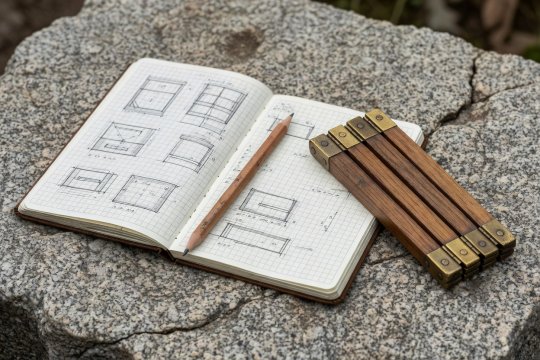
Open gridded field notebook with pencil plan sketches resting beside a brass-hinged wooden folding rule on a granite slab
ARCHIVE NOTE — Direct field measurements from Uppland and Skåne inform every ratio published on this site.
M2
THREE EDITORIAL PRINCIPLES

How we approach every plot study

01. INCREMENTAL SHIFT OVER DEMOLITION

We never recommend stripping a mature garden back to bare clay. Moving one path by ninety centimeters and planting four hornbeam pillars can transform how an entire plot reads in a single weekend.

02. HONEST REGIONAL MATERIALS

We focus on materials that endure forty freeze-thaw cycles a year and improve with moss and lichen: split granite, crushed regional stone, untreated larch, and hardy woodland perennials.

03. VERIFIABLE DIMENSIONS

Instead of vague adjectives like "generous" or "cozy," we state exact centimeter ranges for path widths, stride pacing, sub-base depths, and planting centers.