CHAPTER 01 — PROPORTION, AXES & REPEATED FIGURES NORDIC SPATIAL STUDIES
STRUCTURAL STUDIES — GEOMETRY

Geometry Beneath the Green

When gardeners hear the word "geometric," they often picture Versailles-style symmetry that demands endless clipping. In Scandinavian landscape craft, geometry works differently: it acts as a quiet carpenter's square beneath wilder textures, giving the eye a clear frame so natural plants can relax.

A1
HISTORICAL PRECEDENT — C.TH. SØRENSEN & S.I. ANDERSSON

Why repeating one simple shape calms a plot

In 1948, Danish landscape architect Carl Theodor Sørensen designed the De Runde Haver (Oval Allotment Gardens) in Nærum, just north of Copenhagen. Rather than slicing the hillside into a rigid checkerboard of fenced rectangles, he laid out forty oval privet enclosures—each roughly 25 by 15 meters—floating freely across a shared green meadow.

Walk between those ovals today and you experience a remarkable spatial puzzle: the narrow grassy corridors between curving hedges constantly contract and widen. You never see the entire site at once, yet you never feel lost because every hedge follows the same gentle radius.

You can borrow this exact principle on a home plot of 120 square meters. Instead of mixing a curved kidney-shaped lawn, a hexagonal gazebo, a diagonal path, and rectangular vegetable beds, choose one primary figure—either the offset rectangle, the circle, or the 60-degree triangle—and repeat it at three different scales.
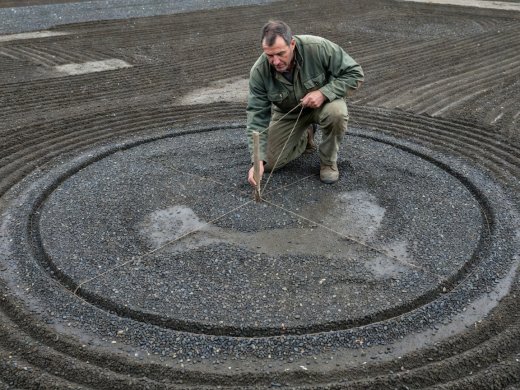
Gardener using a center stake and taut cord to scribe a four-meter circle into damp raked gravel
FIG 1.1 — Scribing a 4.2m radius gravel court using a central rebar pin and non-stretch mason twine.
A2
PROPORTIONAL RATIOS FOR REAL YARDS

Three geometric frameworks you can stake out in an afternoon

01. THE SLIDING RECTANGLE (3:5 RATIO)

A rectangle measuring 3 meters by 5 meters (or 2.4m × 4m in tighter town gardens) feels balanced whether viewed lengthwise or crosswise. By placing two 3:5 rectangles so they overlap at one corner by a single square meter, you create a natural L-shaped circulation route around the outside and a shared planting hinge at the overlap.

02. THE 45-DEGREE ROTATED GRID

In a narrow terraced garden flanked by parallel timber fences, laying paving slabs parallel to the fences emphasizes the tunnel effect. Rotating your central lawn or gravel square by 45 degrees directs your gaze toward the diagonal corners—the longest sightlines available in any rectangle—and leaves triangular pockets along the sides for deep multi-stem shrubs.

03. TANGENT CIRCLES IN TURF

Two circles that barely touch (or sit 80 cm apart, connected by three granite stepping stones) divide a family garden into an active sunny lawn and a quiet evening fire-bowl circle. Edge both circles with flush granite cobbles so mower wheels ride cleanly around the circumference.

Plot Width Recommended Primary Figure Ideal Offset / Overlap Suggested Edging Material
Under 6 meters (Townhouse strip) 45° Rotated Squares (2.5m × 2.5m) 60 cm corner overlap 6 mm × 100 mm flat raw steel strip
6 to 12 meters (Suburban plot) Sliding 3:5 Rectangles 1.2 m lateral shift Split gray granite setts (10 × 10 × 10 cm)
Over 12 meters (Open or rural plot) Interlocking Circles / Ovals 1.8 m meadow corridor between rings Crisp half-moon spade cut or mown verge
A3
FIELD TECHNIQUE — THE 3-4-5 BUILDER'S TRIANGLE

How to square a garden bed without laser tools

When laying out rectangular puzzle beds or orthogonal paths, the human eye easily misjudges a 90-degree corner by five or six degrees—especially if your boundary fence is slightly skewed or the ground slopes away from the house. A crooked right angle becomes immediately noticeable once square pavers are laid.

Use the classic 3-4-5 carpenter's rule with three wooden pegs and a 12-meter tape measure:

  1. Establish your baseline string parallel to the house wall (or your chosen axis) and mark Point A and Point B exactly 3 meters apart.
  2. Pull a second string roughly perpendicular from Point A and mark Point C at 4 meters.
  3. Measure the diagonal distance between Point B and Point C. Shift Point C left or right until that diagonal measures exactly 5 meters. Your corner at Point A is now a true 90-degree angle.
WHEN TO BREAK YOUR OWN GRID

At Gunnar Asplund and Sigurd Lewerentz's Woodland Cemetery (Skogskyrkogården) south of Stockholm, strict geometric stone thresholds intentionally yield whenever they meet an established Scots pine trunk. If your string line runs into a mature apple tree or a large glacial boulder, do not cut the tree—notch your geometric edge cleanly around the root flare and let the trunk act as an anchor.

NEXT: PATHWAYS THAT INVITE WANDERING